


Cardboard Food Packaging: A Complete Guide to Types, Compliance, Certifications and Recyclability
Cardboard is one of the most widely used materials in industrial food packaging, thanks to its combination of strength, versatility, customisation options and recyclability. Cardboard food packaging represents a strategic solution for companies looking for technical performance, food safety and a strong focus on sustainability.
Choosing cardboard food packaging, however, requires a careful assessment of several aspects: from the type of material and the required performance to food contact requirements and regulatory obligations concerning packaging and packaging waste. In particular, the European Packaging and Packaging Waste Regulation (PPWR – Regulation (EU) 2025/40) has introduced a new European regulatory framework aimed at reducing the environmental impact of packaging and promoting circularity.
In this context, Cartonpack Group offers an integrated paper and cardboard supply chain, together with specialised expertise, to support its customers in the design and production of packaging for the food industry.
Find out more HERE.
Primary, Secondary and Tertiary Packaging: What Are the Differences?
Before exploring the characteristics of cardboard in greater detail, it is important to distinguish the main packaging categories according to their function.
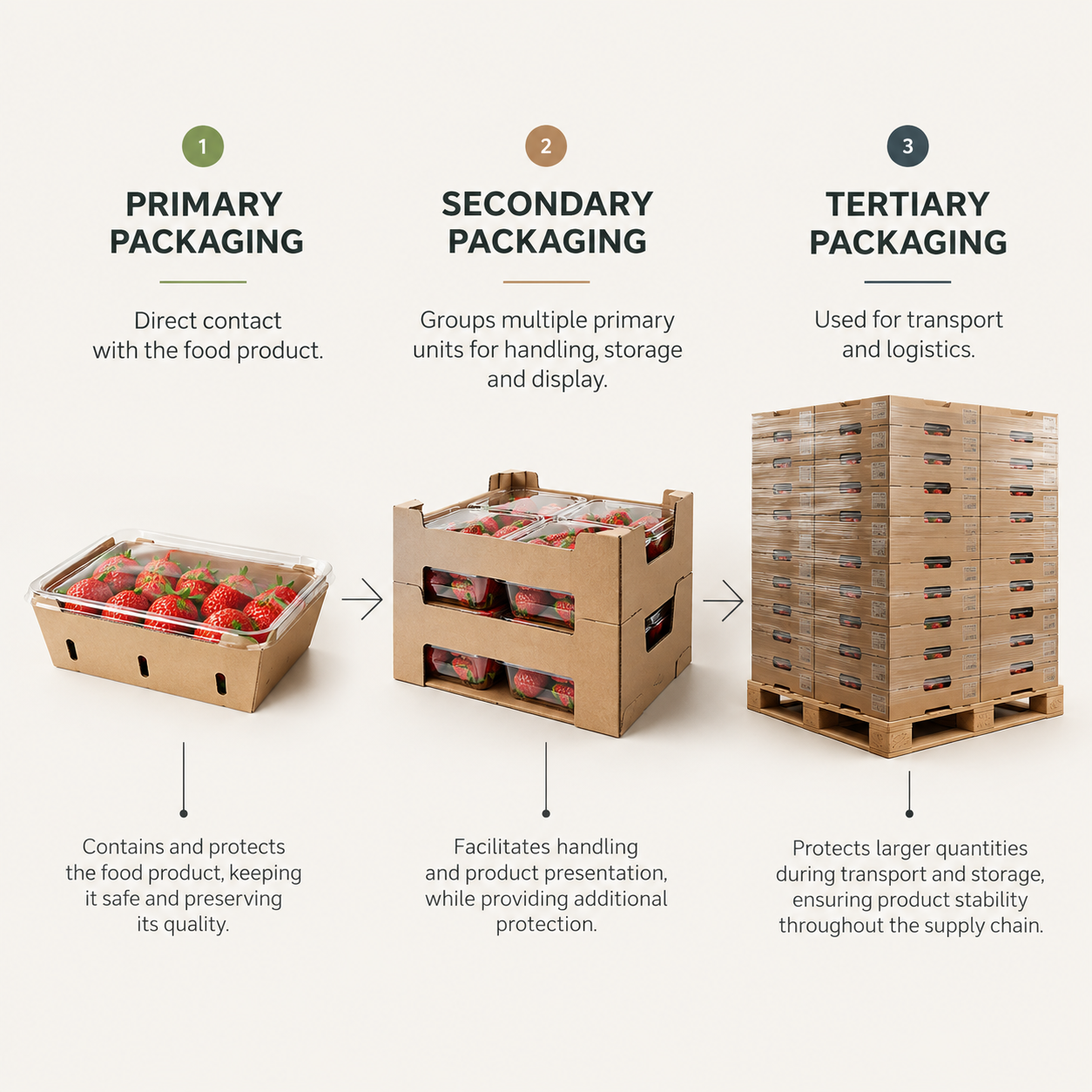
Primary packaging is in direct contact with the food product or is otherwise intended to contain it directly.
Secondary packaging groups multiple sales units together, facilitating handling, protection and product presentation.
Tertiary packaging, on the other hand, is primarily designed to facilitate transport, storage and distribution throughout the supply chain.
This distinction is also fundamental during the design process, as each level of packaging addresses specific requirements in terms of protection, strength, logistics and materials.
Why Cardboard Is One of the Most Widely Used Materials for Food Packaging
Cardboard packaging offers a balance between technical performance, production efficiency and recyclability. This makes it an established solution for food manufacturers, converters and large-scale retail (GDO).
The versatility of the material also makes it possible to develop different solutions depending on the product and its intended use, including multi-material structures when specific barrier properties are required.
Technical properties that make the difference
The mechanical and design characteristics of cardboard make it possible to develop food packaging solutions that protect the product while optimising handling, storage and transport. In the case of corrugated cardboard, GIFCO (Italian Group of Corrugated Cardboard Manufacturers) highlights the material’s central role in the Italian agri-food supply chain, emphasising its widespread use in primary, secondary and tertiary packaging.
The main technical advantages of cardboard packaging include:
These characteristics make cardboard a particularly versatile material for developing packaging solutions for the different stages of the food supply chain, from production through to distribution and retail shelves.
Sustainability and Circularity: A Measurable Advantage
The sustainability of packaging does not depend solely on the material used, but must be assessed by considering the solution’s entire life cycle, from the choice of raw materials and production through to end-of-life management.
For cardboard packaging, the use of virgin fibres sourced from certified supply chains, such as those certified by the FSC® (Forest Stewardship Council), or recycled fibres can contribute to developing solutions aligned with the principles of the circular economy.
Recyclability is also becoming an increasingly important factor in packaging choices. In the 2025 Large-Scale Retail Packaging Observatory, Nomisma reports that 51% of purchasing decision-makers consider full recyclability a key characteristic of sustainable packaging, while 40% identify the use of raw materials from renewable sources as an important factor.
It is precisely at the intersection of performance, innovation and sustainability that Cartonpack Group’s approach takes shape, with solutions designed to meet the needs of the food industry and respond to the evolving European regulatory framework.
Discover more about Cartonpack Group’s commitment to sustainability.
Types of Cardboard Food Packaging
Every application requires a packaging solution designed around the characteristics of the product and the needs of the supply chain. The choice between corrugated cardboard, solid board, rigid board and food-grade cartonboard depends on the function of the packaging, the level of protection required, the type of food being packaged, and the methods used for transport, storage and distribution.
Paper and cardboard packaging solutions must be designed by considering technical performance, food safety, recyclability, print quality and compatibility with automated packaging processes at the same time.
Corrugated Cardboard: Ideal for Secondary and Tertiary Packaging, and More
Corrugated cardboard is one of the main solutions used for the transport, handling and distribution of food products. Its structure, consisting of one or more fluted layers inserted between flat sheets, provides a good balance of strength, weight and shock-absorption capacity.
For this reason, corrugated cardboard is widely used for secondary and tertiary packaging intended for logistics and distribution. Low-profile flutes, such as E, F and N flutes, can also be used to produce retail-ready and display packaging, including certain solutions for fruit and vegetables.
The main configurations include:
Within the Group, Ondapack Sud specialises in the production and printing of corrugated cardboard, developing solutions that combine structural strength, graphic quality and logistics efficiency.
Folding Carton and Rigid Board: Solutions for Primary and Secondary Packaging
Folding cartonboard is used to produce various types of packaging for the food sector, particularly where dimensional precision, print quality, visual appeal and functionality are required. Depending on the structure and characteristics of the material, these solutions can be used for both primary and secondary packaging, including folding cartons, trays and packs for different categories of food products, such as pasta, cereals, baked goods and fresh packaged foods.
Rigid board, on the other hand, offers specific structural properties and is used in applications requiring greater packaging rigidity and stability.
Micro-fluted board is also an interesting solution for combining the strength of a corrugated structure with a surface suitable for high-quality printing and graphic enhancement of the packaging.
Within the Group, Fimat and Cartotecnica specialise in the processing of folding cartonboard, rigid board and micro-fluted board, developing solutions for the food industry that combine functionality, brand communication and production efficiency.
Food-Grade Cartonboard for Direct Food Contact
Food-grade cartonboard intended for direct contact with food must be designed and manufactured in compliance with specific safety and regulatory requirements. The choice of material depends on the type of food, the conditions of use and the performance required from the packaging. Key solutions include:
Material selection must therefore take into account not only food safety, but also shelf life, storage conditions and the physical and chemical characteristics of the food.
When high barrier properties against moisture, grease or oxygen are required, the design of the packaging structure becomes particularly important. Laminated or multi-material solutions can help achieve the required performance, while also considering their impact on the packaging’s recyclability and end-of-life management.
Compliance: Requirements for Cartonboard Intended for Food Contact
At European level, the general reference for materials and articles intended to come into contact with food is Regulation (EC) No. 1935/2004, which establishes the general safety requirements applicable to Food Contact Materials (FCMs).
This is complemented by Regulation (EC) No. 2023/2006 on Good Manufacturing Practices (GMP), which sets out good manufacturing practices for materials and articles intended to come into contact with food and requires operators to implement management and quality control systems appropriate to their position within the supply chain.
For paper and cardboard, unlike other materials such as plastics, there is currently no specific harmonised measure at European level. In Italy, the provisions of Ministerial Decree of 21 March 1973, together with its subsequent amendments and updates, apply and also regulate paper and cardboard intended for food contact.
The regulatory framework must also be considered alongside any relevant industry guidelines and technical standards, which can support the assessment of material suitability and the management of applicable requirements.
A key element of compliance is the Declaration of Compliance, through which the manufacturer documents that the material or packaging meets the applicable requirements and provides the information needed by operators throughout the supply chain.
For this reason, choosing a specialised partner is important not only for packaging performance, but also for managing controls, technical documentation, traceability and compliance checks.
Do you need food-contact packaging that complies with current regulations?
Cardboard Recyclability: A Benchmark for Excellence
The recyclability of packaging largely depends on the design choices made during its development. The selection of materials, the presence of coatings and finishes, adhesives, inks and the possible use of multi-material structures can all affect the ability to effectively separate, sort and recycle packaging at the end of its life.
Solutions based on a mono-material structure can simplify the recycling process, while packaging that incorporates plastic, metallised or other material barriers requires a specific assessment of its compatibility with the collection, sorting and recycling systems available.
Corrugated cardboard, for example, is normally collected through paper and cardboard recycling streams. However, its actual recyclability must be assessed according to the composition of the packaging and the characteristics of the finished solution.
In this context, the principle of Design for Recycling (DfR) is becoming increasingly important. This means designing packaging with its recyclability and the possibility of recovering its material at the end of its life in mind from the very beginning.
DfR is particularly relevant in light of the PPWR, which introduces harmonised criteria for assessing the recyclability of packaging placed on the European market.
Industrial Applications of Cardboard Food Packaging
Cardboard food packaging is used across the main segments of the food industry, from production to distribution. The ability to combine mechanical strength, print quality, food safety, functionality and recyclability makes it possible to develop solutions tailored to the characteristics of the product and the needs of the supply chain.
Thanks to an integrated supply chain and specialised expertise in the processing of corrugated cardboard, folding cartonboard and multi-material solutions, Cartonpack Group supports food companies, manufacturers and retailers in designing high-performance packaging solutions across the entire supply chain.
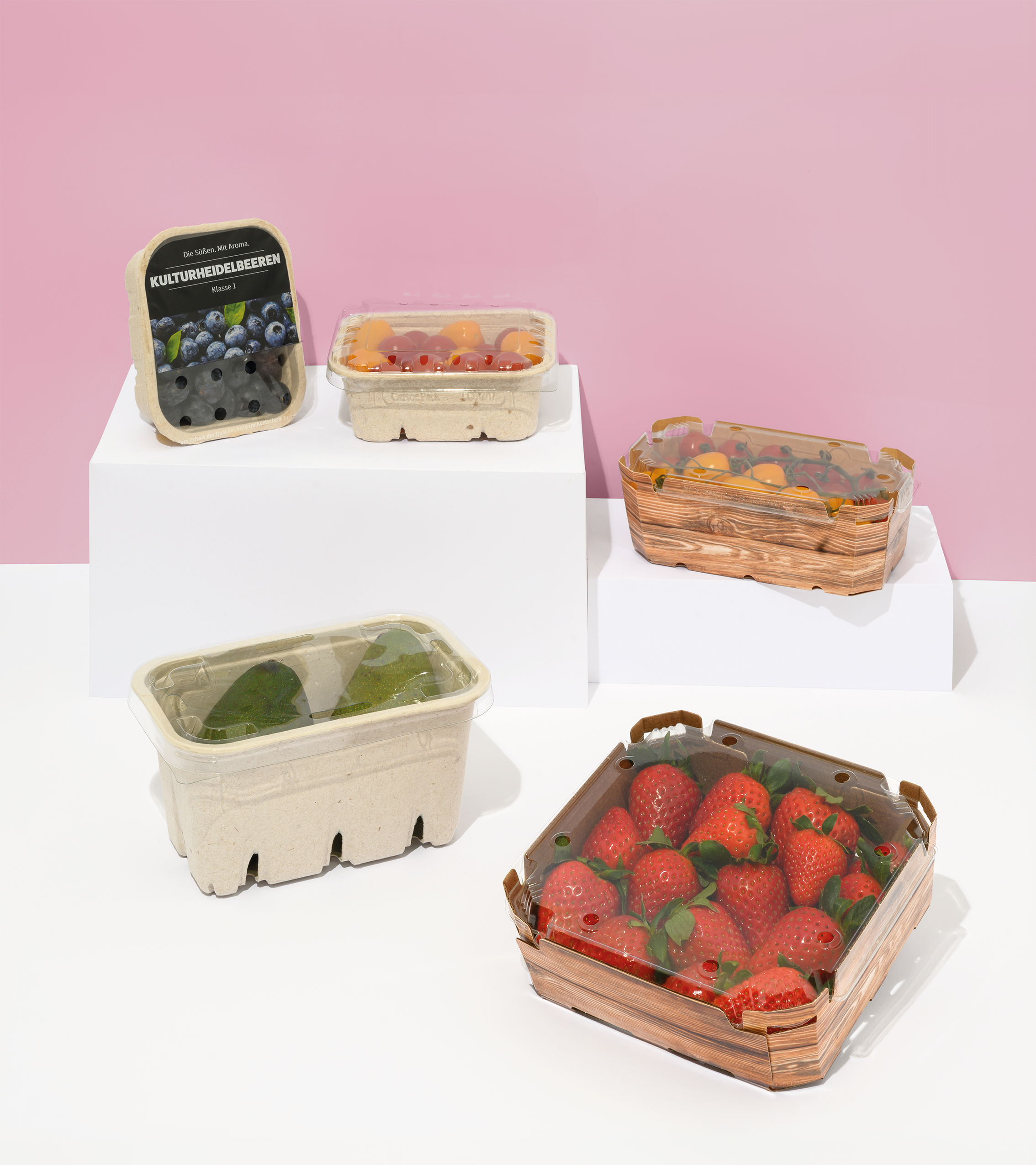
Fruit and Fresh Produce
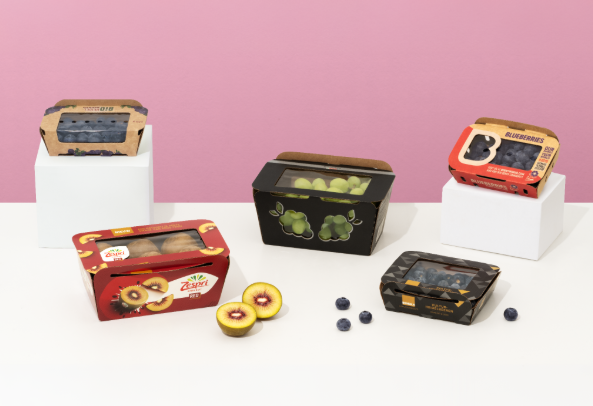
The fresh produce sector is one of the main application areas for cardboard packaging for fruit and vegetables. In this sector, packaging must protect the product, promote ventilation and provide adequate strength even in the presence of moisture and low temperatures.
Key solutions include:
Packaging design must also take into account the evolving regulatory framework governing food-contact materials. In particular, Regulation (EU) 2025/40 includes specific provisions concerning per- and polyfluoroalkyl substances (PFAS) in packaging, with the aim of limiting their presence and use from 12 August 2026 onwards. It is therefore increasingly important to select materials and solutions that comply with the requirements applicable to their specific intended use.
Cartonpack Group has been active in the international fresh produce sector for many years and participates in leading industry events, including Fruit Logistica, Fruit Attraction, Macfrut and Berry Congress, developing solutions for growers, packers and distributors.
Dry, Packaged Foods and Snacks
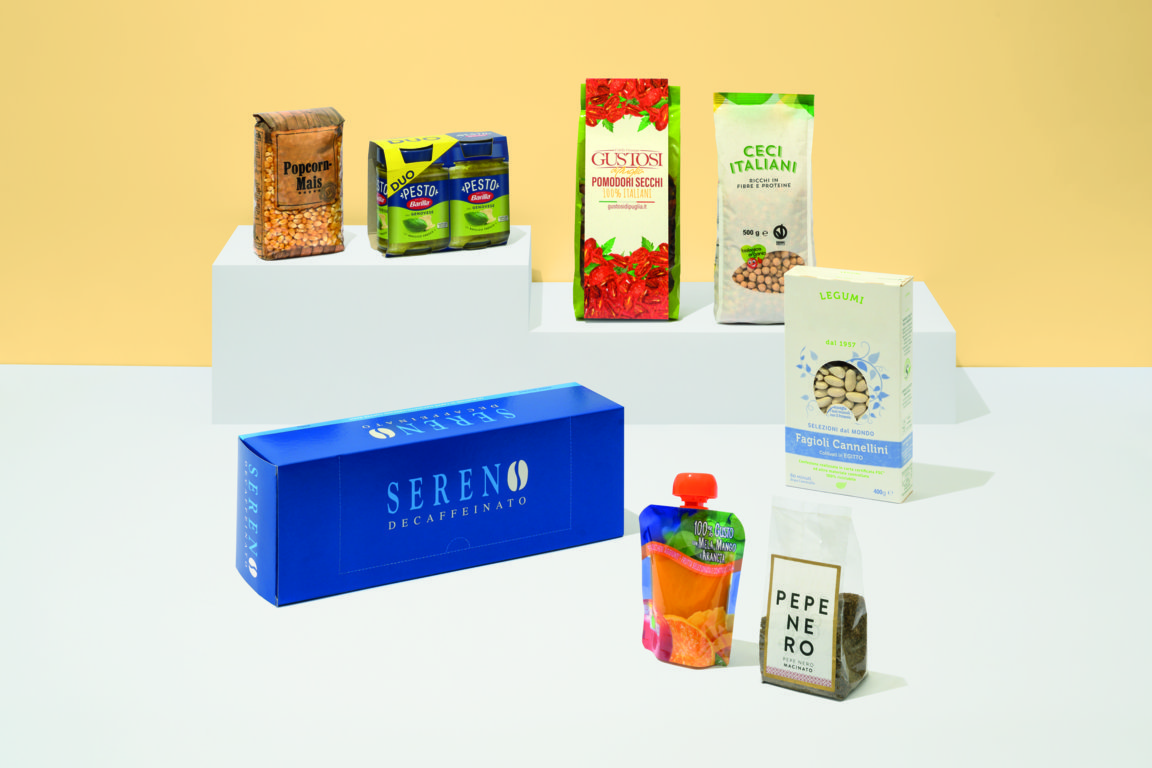
For cereals, pasta, rice, baked goods and snacks, folding cartonboard is a widely used solution thanks to its dimensional precision, high-quality printing and ability to integrate with automated packaging processes.
When specific barrier properties against moisture, oxygen or grease are required, the packaging design may incorporate coatings, barrier layers or multi-material structures, depending on the characteristics of the product and the required shelf life.
Snack and on-the-go formats also require increasingly lightweight, functional solutions optimised for transport, display and consumption. In this context, designing according to Design for Recycling principles is becoming increasingly important, particularly in light of the evolving regulatory framework introduced by the PPWR.
Retail and Logistics
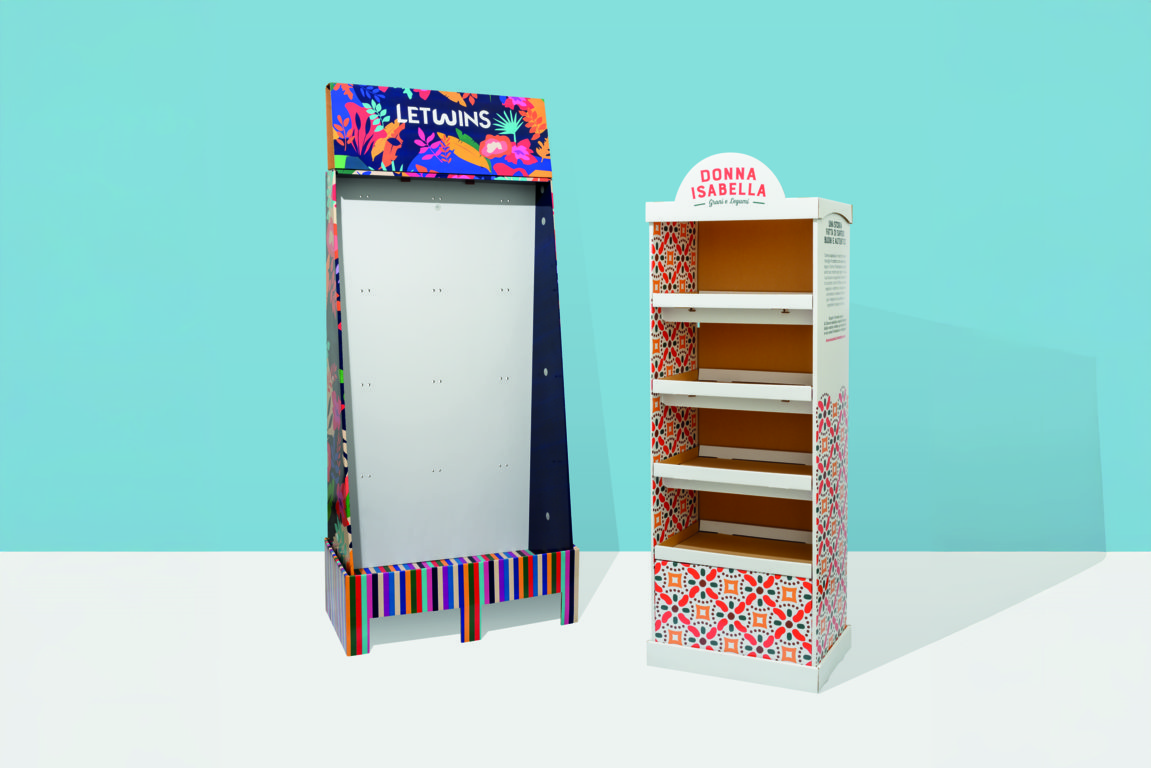
For large-scale retail (GDO), cardboard used for secondary and tertiary packaging plays an essential role in handling, product display and goods management throughout the supply chain.
Key applications include:
In addition to mechanical strength, these packaging solutions can integrate high-quality printing, identification and traceability systems, such as QR Codes and RFID technologies, as well as solutions designed to optimise weight and volume.
In this context, packaging design must also take into account the packaging reduction and recyclability targets introduced by the PPWR.
Ondapack develops solutions specifically designed to meet these requirements, combining structural performance, print quality and production efficiency.
Discover Cartonpack Group’s paper and cardboard solutions for large-scale retail and the food industry.
How to Choose a Cardboard Food Packaging Supplier
Choosing a cardboard food packaging supplier can have a significant impact on packaging quality, production continuity and regulatory compliance management. For this reason, it is important to assess not only the cost of the packaging, but also the technical expertise, certifications, production capacity and design support offered by the partner.
A specialised manufacturer should first have management systems and certifications consistent with the applications it serves. Standards such as FSC®, FSSC 22000 and IFS PACsecure, where relevant to the specific production site and product type, can provide useful criteria for assessing raw material management, food safety and process quality.
A second key aspect is multi-material expertise. Not every application can be addressed with a structure made exclusively from paper or cardboard. In some cases, special papers, coatings, barrier layers or technical films need to be integrated to deliver the performance required by the product and its intended shelf life. The choice should be made by considering food safety, functional performance and recyclability at the same time.
It is also important to ensure that the supplier considers Design for Recycling principles from the design stage, in line with the evolving requirements introduced by the Packaging and Packaging Waste Regulation (PPWR). Designing with future regulatory developments in mind can help reduce the risk of having to modify packaging at a later stage.
Another important factor is an integrated supply chain. Having in-house expertise in design, production, converting, printing and quality control can help improve process traceability, optimise development times and ensure greater supply continuity.
Finally, it is important to consider the supplier’s experience in the food industry. The needs of a fresh produce producer, a packaged food manufacturer or a large-scale retailer can vary considerably and require specific expertise in materials, production processes and packaging conditions of use.
With 9 production sites, 3,000 customers in more than 50 countries and an integrated paper and cardboard supply chain, Cartonpack Group provides the expertise and production capabilities to support food companies in developing reliable, compliant cardboard packaging solutions aligned with evolving regulatory requirements.
The integration of Cartotecnica, Fimat and Ondapack enables the Group to offer complementary expertise, from material selection and processing to the development of the solution best suited to specific production requirements.
Design Your Next Packaging Solution with Cartonpack Group
The evolution of the food market requires packaging solutions that are increasingly high-performing, safe, recyclable and designed in line with the evolving European regulatory framework.
Choosing a specialised partner means having access to technical expertise, production capabilities and in-depth knowledge of materials, from the initial design stage through to the production of the finished solution.
Cartonpack Group develops paper and cardboard food packaging solutions designed to meet the needs of the food industry, with an approach focused on food safety, performance, recyclability and Design for Recycling.
Do you have a packaging project to develop? Talk to us about your project.