

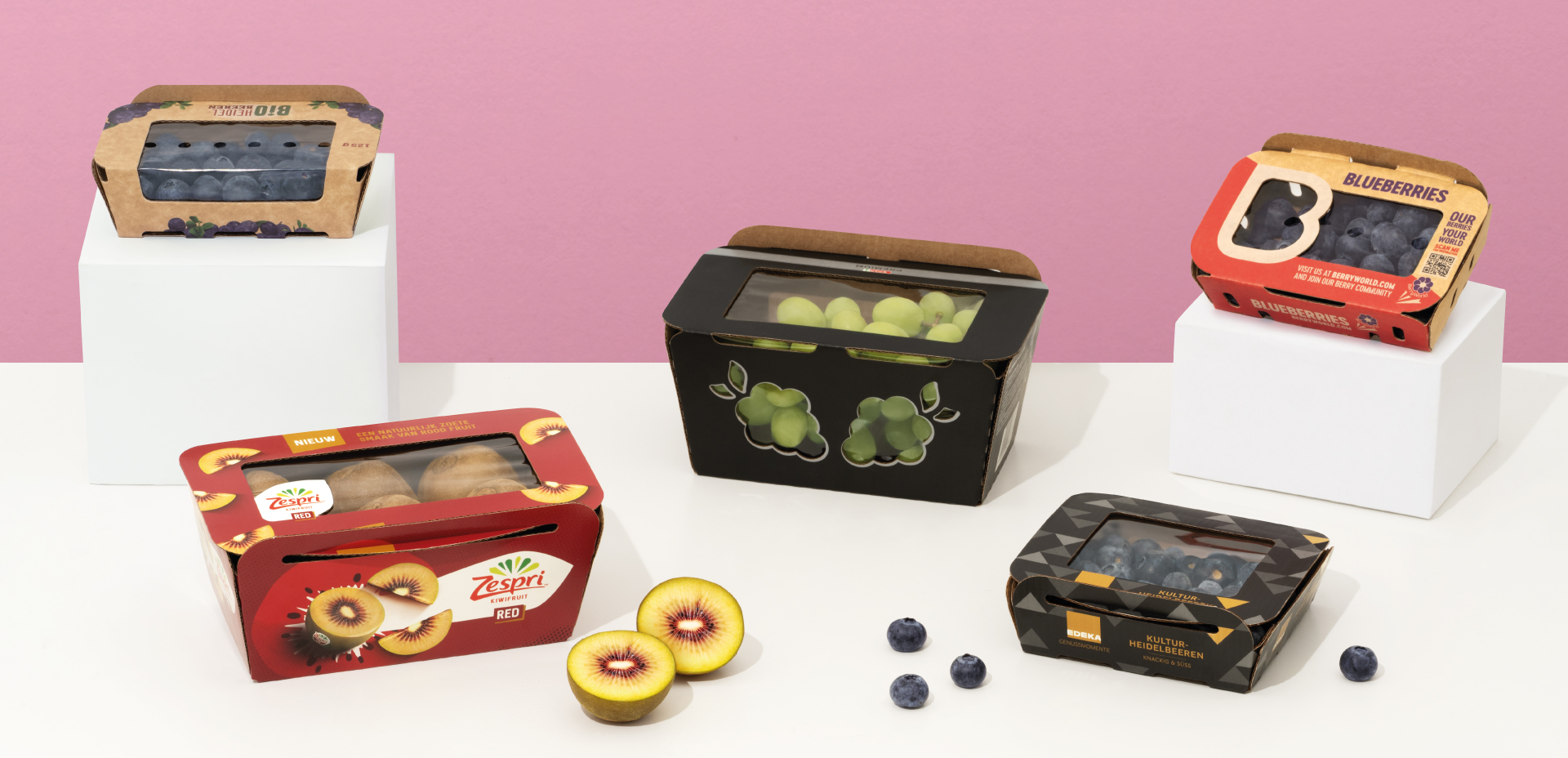

PPWR 2026: A Complete Guide to the New European Packaging Regulation
PPWR 2026: A Complete Guide to the New European Packaging Regulation
From 12 August 2026, the Packaging and Packaging Waste Regulation (PPWR) will become fully applicable across the European Union. For companies operating in the food industry that manufacture, purchase or use packaging, this is far more than a regulatory update. It represents a fundamental transformation affecting packaging design, material selection, regulatory compliance and end-of-life packaging management.
Regulation (EU) 2025/40, known as the Packaging and Packaging Waste Regulation (PPWR), introduces new requirements that directly impact food contact packaging. These range from PFAS restrictions and the EU Declaration of Conformity to recyclability requirements and minimum recycled content targets, with obligations extending through to 2040.
As a result, many businesses are already reviewing their packaging portfolios to ensure compliance with the new legislation. Cartonpack Group is addressing this transition through its PPWR Ready approach, developing innovative multi-material packaging solutions designed to meet the requirements of the new European Packaging Regulation.
What is the PPWR and Why Is It Reshaping the Packaging Industry?
The Packaging and Packaging Waste Regulation (PPWR) represents the most significant overhaul of European packaging legislation in decades.
The Regulation aims to accelerate the transition towards a circular economy by reducing packaging waste and increasing the recyclability of the materials used across the European market.
From Directive to Regulation: What Changes in Practice?
The previous Directive 94/62/EC required each Member State to transpose its provisions into national law, resulting in different interpretations and varying implementation across European markets.
The PPWR, by contrast, is a directly applicable Regulation in all 27 European Union Member States. This establishes a harmonised legal framework with uniform rules, shared requirements and greater market consistency. Its provisions also apply to packaging imported from countries outside the European Union.
The restriction on PFAS is the first major operational requirement that food businesses must address, with compliance becoming mandatory from 12 August 2026.
What Are PFAS and Why Does the PPWR Restrict Them?
PFAS (Per- and Polyfluoroalkyl Substances) are a group of synthetic chemicals widely used across numerous industrial applications due to their water-, grease- and stain-resistant properties.
In the food packaging sector, they may be present in:
• Baking paper
• Fast-food containers
• Popcorn bags
• Barrier films and other food contact materials
The PPWR significantly restricts the use of PFAS because these substances are highly persistent in the environment and have the potential to bioaccumulate, meaning they build up in the tissues of living organisms faster than they can be broken down or eliminated.
The Regulation establishes the following maximum limits:
• 25 ppb for any individual PFAS substance;
• 250 ppb for the total concentration of PFAS;
• 50 mg/kg for total fluorine content.
To demonstrate compliance, companies must implement appropriate analytical testing procedures and obtain up-to-date technical documentation and certified declarations from their suppliers.
The technical verification process includes the following analytical stages:
• Total Organic Fluorine (AOF) Screening: a preliminary screening test used to identify potential exceedances of the regulatory thresholds. Positive results trigger further analytical investigations.
• Liquid Chromatography–Mass Spectrometry (LC-MS/MS or UHPLC-Q-TOF): the reference analytical technique for the identification and accurate quantification of individual PFAS compounds, such as PFOA and PFOS, within packaging materials.
• Migration Testing: a testing procedure designed to simulate real food-contact conditions in order to assess the potential migration of chemical substances from the packaging material into the food product.
What Are PFAS and Why Does the PPWR Restrict Them?
A Five-Step Action Plan to Achieve PPWR Compliance
Companies using food packaging should begin implementing a structured action plan without delay to ensure compliance with the new regulatory requirements.
1. Map Your Entire Packaging Portfolio
Identify all packaging materials and formats used across the business, with particular attention to those at higher risk of containing PFAS. Create a centralised inventory of all food contact packaging materials to establish a clear compliance baseline.
2. Audit Your Supply Chain and Improve Supplier Transparency
PFAS are often introduced through non-visible layers or during manufacturing processes carried out by upstream suppliers. Generic self-declarations are not legally sufficient. Companies should formally request updated Declarations of Conformity (DoCs) and analytical test reports from their suppliers, while establishing clear contractual responsibilities throughout the supply chain.
3. Implement an Analytical Testing Programme
Verify the actual compliance of packaging materials through accredited laboratory testing. Testing should confirm compliance with all three regulatory thresholds established under the PPWR.
4. Redesign Packaging Solutions and Evaluate Alternative Materials
Replace non-compliant materials and fluorinated chemical treatments with safer alternatives, such as natural biopolymers, mechanically treated paper, algae-based coatings or microfibrillated cellulose. New PFAS-free packaging solutions should undergo stability and shelf-life testing to ensure they continue to deliver the required grease-resistant performance and product protection.
5. Strengthen Documentation and Data Governance
Collect, centralise and maintain all analytical data to support regulatory audits and inspections by health and customs authorities. Analytical test results and supplier certifications should be incorporated into the technical documentation for each product, ensuring that the company's Food Contact Materials (FCM) Declaration of Conformity remains accurate, complete and up to date.
The Objectives: Less Waste, Greater Circularity
According to the European Commission, each EU citizen generated an average of 178 kg of packaging waste in 2023.
The PPWR aims to reverse this trend by introducing ambitious targets designed to promote a more circular packaging economy:
• A 5% reduction in packaging waste by 2030;
• A 10% reduction by 2035;
• A 15% reduction by 2040;
• 100% recyclability of all packaging placed on the EU market by 2030;
• Increased use of recycled plastic in packaging applications;
• The progressive phase-out of hazardous substances, including PFAS.
Key Deadlines Under Regulation (EU) 2025/40
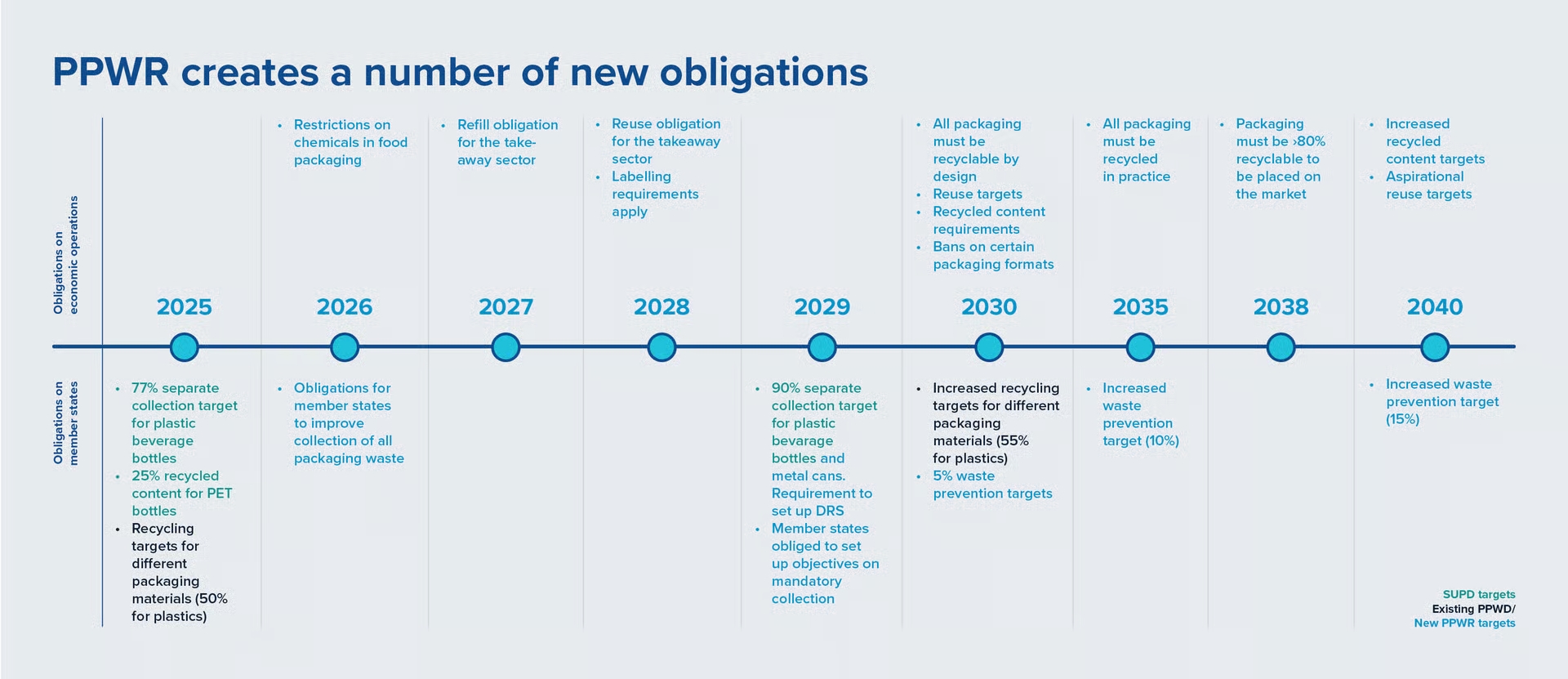
Understanding the PPWR implementation timeline is essential for planning investments and ensuring packaging compliance with the new regulatory requirements.
12 August 2026: The First Major Compliance Deadline
From 12 August 2026, the first operational obligations under the PPWR will come into force:
• PFAS restrictions for food contact packaging exceeding the permitted thresholds;
• Mandatory registration with Extended Producer Responsibility (EPR) schemes;
• Issuance of an EU Declaration of Conformity for each packaging type;
• Compliance with the general recyclability requirements set out in Article 6 of the Regulation.
No transitional period is provided for newly placed products. Any packaging placed on the market from this date onwards must fully comply with the new regulatory requirements.
Retail and Takeaway Requirements (2027–2029)
• 2027: Bars, cafés and restaurants will be required to allow customers to use their own reusable containers for takeaway food at no additional cost.
• 2028: The introduction of harmonised packaging labelling will become mandatory, helping consumers correctly sort packaging waste and improving recycling across the European Union.
• 2029: Member States will be required to implement Deposit Return Schemes (DRS) for single-use plastic beverage bottles and aluminium cans.
2030: A Turning Point for Packaging Design and Recycling
From 2030 onwards, the PPWR introduces a new set of mandatory design requirements:
• Mandatory recyclability: all packaging placed on the EU market must be designed for recycling (Design for Recycling).
• Minimum recycled content: mandatory minimum levels of post-consumer recycled plastic must be incorporated into new plastic packaging.
• Single-use packaging restrictions: selected single-use packaging formats will be banned, including packaging for fresh fruit and vegetables (under 1.5 kg), single-portion packaging used in hotels and restaurants (such as sauce sachets and miniature toiletry bottles), and plastic luggage wrapping at airports.
• Reuse targets: large retailers will be required to dedicate at least 10% of their retail space to refill and reusable packaging systems.
Long-Term Targets (2035–2040)
• 2035: Packaging with low recyclability performance (Performance Grade C) will no longer be permitted on the EU market. Only packaging achieving Performance Grades A or B will be allowed.
• 2040 – The Final Milestone: The Regulation sets a mandatory 15% per capita reduction in packaging waste compared with 2018 levels. Reuse targets for transport packaging and beverage packaging will also increase significantly, reaching up to 70% for certain packaging categories.
Minimum Recycled Plastic Content
The PPWR establishes minimum recycled content targets for plastic packaging, introducing progressively higher requirements over time.
For the food packaging sector, compliance is particularly challenging, as recycled plastics intended for food contact applications must also comply with Regulation (EU) 2022/1616 on recycled plastic materials and articles intended to come into contact with food.
Under the PPWR, all plastic packaging will be required to meet mandatory minimum levels of post-consumer recycled content.
Cartonpack Group has already developed a range of rPET thermoformed packaging solutions containing more than 90% recycled material, while maintaining the highest standards of food safety and industrial performance.
EU Declaration of Conformity and Documentation Requirements
The PPWR establishes a comprehensive regulatory framework that redefines the responsibilities of every stakeholder involved in the packaging lifecycle.
The Regulation clearly distinguishes the roles and obligations of each economic operator, creating a structured compliance system in which responsibilities depend not only on the activities performed, but also on the geographical market in which the operator places packaging on the market.
Who Is the Manufacturer Under the PPWR?
The cornerstone of the PPWR framework is the definition of the Manufacturer. This role applies to any company that manufactures a packaged product, commissions its production by a third party on its behalf, or packages—or has a product packaged—and places it on the market under its own brand.
Unlike other economic operators, the Regulation establishes that each individual packaging item can have only one Manufacturer, ensuring a single, clearly identifiable entity responsible for product compliance and traceability throughout its lifecycle.
Supporting the Manufacturer is the Supplier, a term that covers any business providing packaging components or manufacturing packaging on behalf of third parties.
The regulatory framework further distinguishes between the roles of Producer and Distributor.
The Producer is the economic operator that first places packaging or a packaged product on the market within a specific EU Member State. As a result, the same packaged product may have different Producers if it is introduced into multiple EU countries.
The Distributor, by contrast, is responsible solely for making the product available on the market or transferring it within the supply chain, without modifying its characteristics or compliance status.
The complexity of the PPWR lies in the fact that these roles may overlap depending on the market in which a company operates. For example, a business selling products within its domestic market may act as the Producer, while the same company exporting those products to another EU Member State may assume the role of Distributor.
This flexible allocation of responsibilities requires companies to carefully assess their operations, as the PPWR assigns specific legal obligations to each economic operator. Correctly identifying each role is therefore a fundamental prerequisite for achieving compliance with the new European packaging legislation.
Within this framework, documentation and regulatory compliance become one of the most critical aspects of the new Regulation.
Documents to Prepare by August 2026
Manufacturers placing packaged products on the market under their own name or brand will be required to prepare the following documentation:
• The EU Declaration of Conformity in accordance with Regulation (EU) 2025/40 (PPWR);
• Supporting technical documentation provided by the relevant Supplier(s);
• Registration with the applicable Extended Producer Responsibility (EPR) schemes;
• Certifications relating to PFAS, heavy metals, and Substances of Very High Concern (SVHCs).
Cartonpack Group supports its customers by providing the technical documentation and material certifications required to complete the Manufacturer's EU Declaration of Conformity, helping businesses meet the documentation requirements of the PPWR.
Is Your Packaging PPWR Ready?
Want to find out whether your packaging already complies with the new PPWR requirements? Contact our team for a tailored compliance assessment.
Harmonised Packaging Labelling: What Changes from 2028?
The PPWR introduces harmonised packaging labels featuring standardised pictograms that identify packaging materials and provide clear disposal instructions. The aim is to improve waste sorting, enhance consumer understanding and ensure that labelling is accessible, including for people with disabilities.
Once the harmonised labelling system becomes mandatory, national labelling schemes will no longer be permitted alongside the EU harmonised label. In addition, environmental claims will only be allowed where they refer to environmental performance that goes beyond the minimum legal requirements established by the Regulation.
The PPWR also establishes a clear implementation timeline. The adoption of the necessary implementing acts is scheduled by 12 August 2026, while the harmonised labelling requirements will become fully applicable from 12 August 2028, exactly 24 months after the implementing legislation enters into force.
How to Prepare: The PPWR Ready Approach
Companies looking to stay ahead of upcoming regulatory deadlines should begin implementing a structured compliance strategy without delay.
Through a comprehensive multi-material approach that includes thermoformed plastics, flexible films, paper, cardboard and moulded fibre packaging, Cartonpack Group helps food manufacturers, agri-food businesses and large-scale retailers transition to packaging solutions that comply with the PPWR.
Our packaging portfolio is built around four key pillars:
• Mono-material design for improved recyclability;
• Increased use of recycled materials;
• Innovative paper-plastic hybrid solutions;
• Moulded fibre packaging designed for circularity.
This offering is further strengthened by the innovation developed by Smilesys, whose flexible films made with ISCC PLUS® certified materials help significantly reduce environmental impact while maintaining high performance standards.
Cartonpack Group Is PPWR Ready
Discover our innovative multi-material packaging solutions and prepare your business to confidently meet the challenges of the new European Packaging and Packaging Waste Regulation.
FAQ
Design for recycling
Under the new Packaging and Packaging Waste Regulation (PPWR), it is no longer sufficient for packaging to be theoretically recyclable under laboratory conditions. Packaging must be designed from the outset to ensure it is fully compatible with existing recycling infrastructures and does not interfere with established recycling processes.
Key Principles of Design for Recycling (DfR)
• Mono-material design: Wherever possible, packaging should be made from a single material (e.g. paper or PET only) to facilitate automatic sorting and recycling.
• Component separability: Different packaging elements, such as a plastic cap on a glass bottle, should be easy for consumers or recycling facilities to separate.
• Washable inks and adhesives: Printing inks and adhesives should be removable during industrial washing processes to prevent contamination of recycled materials.
• Neutral colours: The use of dark or opaque pigments, particularly carbon black, should be minimised, as they can interfere with optical sorting technologies used in recycling plants.
• Minimum size requirements: Packaging formats should not be too small, as they may pass through industrial sorting screens and end up in residual waste instead of being recycled.
By 1 January 2028, the European Commission will publish official Design for Recycling (DfR) Guidelines, defining the technical criteria applicable to each packaging format.
Compliance with these criteria will determine a packaging's recyclability performance rating and its classification into one of the official performance grades. Only packaging designed in accordance with the most stringent Design for Recycling requirements will be eligible to achieve Performance Grade A, helping manufacturers avoid regulatory restrictions and potential market bans from 2030 onwards.
Recyclability Performance Classification (Grades A, B and C)
The A, B and C classification system refers to the recyclability performance grades introduced under Article 6 of Regulation (EU) 2025/40 (PPWR). From 1 January 2030, all packaging placed on the European Union market will be required to comply with stringent Design for Recycling (DfR) criteria and be assigned to one of these performance grades in order to remain marketable.
Recyclability Performance Grades
Recyclability performance is determined by the percentage, by weight, of the packaging that can be effectively recycled through existing recycling systems.
• Grade A – Packaging that is 95% or more recyclable by weight.
• Grade B – Packaging that is at least 80% recyclable by weight.
• Grade C – Packaging that is at least 70% recyclable by weight.
Market Implications
The recyclability performance grade will have significant commercial and regulatory implications:
• Minimum 70% recyclability threshold: Packaging with a recyclability rate below 70% will be considered non-recyclable and may no longer be placed on the EU market from 2030, subject to the implementation timetable established by the PPWR.
• Eco-modulation of EPR fees: The assigned performance grade will directly influence Extended Producer Responsibility (EPR) fees. Packaging achieving Grade A is expected to benefit from lower environmental contributions, while Grade C packaging will be subject to less favourable fee structures.
• Consumer information: Recyclability performance grades will need to be communicated clearly and transparently, integrating with the harmonised labelling system that becomes mandatory from 2028, enabling consumers to make more informed disposal decisions.
This performance-based classification encourages manufacturers to incorporate circular design principles from the earliest stages of packaging development, ensuring long-term compliance with European sustainability requirements.
Reuse and Waste Reduction Requirements for Food Packaging
From 1 January 2030, a number of single-use plastic packaging formats will be prohibited, including:
• Single-portion sachets and containers for sauces, condiments and sugar used in the HoReCa sector;
• Single-use packaging for fresh fruit and vegetables weighing less than 1.5 kg;
• Complimentary single-use toiletry bottles provided in hotels.
Scope of the Restrictions
• Food Service (HoReCa): Single-use sachets of ketchup, mayonnaise, mustard, oil, vinegar and sugar served in bars, cafés and restaurants for on-site consumption will be prohibited.
• Fresh Produce: Single-use nets, trays and similar packaging for fresh fruit and vegetables weighing less than 1.5 kg will be banned, except where justified by specific hygiene or food safety requirements.
• Hospitality Sector: Complimentary miniature bottles of shampoo, soap and other toiletries will no longer be permitted in hotels.
• Grouped Packaging: Plastic wrapping used to bundle multiple bottles or beverage cans at the point of sale will be prohibited.
• Beverages: By 2030, at least 10% of packaging used for mineral water, soft drinks, fruit juices, beer and fermented alcoholic beverages must be reusable.
Empty space Ratio
From 1 January 2030, packaging used for e-commerce, transport and grouped products must not contain more than 50% empty space relative to the total volume of the packaging.
What Is Considered "Empty Space"?
The 50% threshold includes everything inside the package that is not the product itself.
Materials counted as empty space include:
• Included materials: The 50% calculation includes everything inside the package that is not the product itself.
• Materials classified as empty space: Expanded polystyrene packing peanuts, bubble wrap, kraft paper void fill and inflatable air cushions are all considered empty space.
• Logistics objective: The requirement aims to eliminate over-packaging, optimise transport efficiency and reduce packaging waste throughout the supply chain.
Key Deadlines and Compliance Requirements
• August 2026: The general principle of packaging minimisation enters into force, requiring manufacturers to minimise packaging weight and volume wherever possible.
• February 2028: The European Commission will publish the official methodology for calculating empty space within packaging.
• January 2030: The mandatory 50% empty space limit becomes fully applicable. Companies exceeding this threshold will be required to justify the additional packaging volume.
Practical Solutions for Compliance
Companies can prepare by adopting packaging optimisation strategies such as:
• Right-sized packaging: Implement automated packaging systems that produce boxes tailored to the exact dimensions of each order.
• Flexible mailers: Replace oversized rigid boxes with flexible shipping bags for non-fragile products.
• Packaging audits: Analyse shipping data to standardise packaging formats based on the dimensions of the most frequently shipped products.
Commission Delegated Decision (EU) 2026/429 officially exempts flexible plastic wrapping (stretch films) and pallet strapping/banding from the 100% reuse requirement under the PPWR.
What Does Delegated Decision (EU) 2026/429 Establish?
• Exemption from reuse requirements: Plastic stretch films and pallet strapping used to stabilise palletised loads are exempt from the obligation to be reusable.
• Scope of the exemption: The exemption applies to intra-company transport between facilities belonging to the same business and to national business-to-business (B2B) transport operations.
• Economic rationale: The European Commission concluded that imposing reusable systems for these flexible packaging materials would create disproportionate costs and disrupt existing automated logistics operations.
Practical Impact for Businesses and E-commerce
• Continued use of stretch films: Warehouses and e-commerce fulfilment centres may continue using single-use recyclable stretch films for pallet wrapping.
• Focus remains on recyclability: Although exempt from reuse obligations, these materials will still need to comply with future Design for Recycling requirements and minimum recycled plastic content targets established by the PPWR.
• Shipping bags remain subject to PPWR rules: Flexible plastic mailing bags used for individual e-commerce parcels delivered to consumers are not covered by this exemption and must therefore comply with the Regulation's packaging minimisation and empty-space requirements.